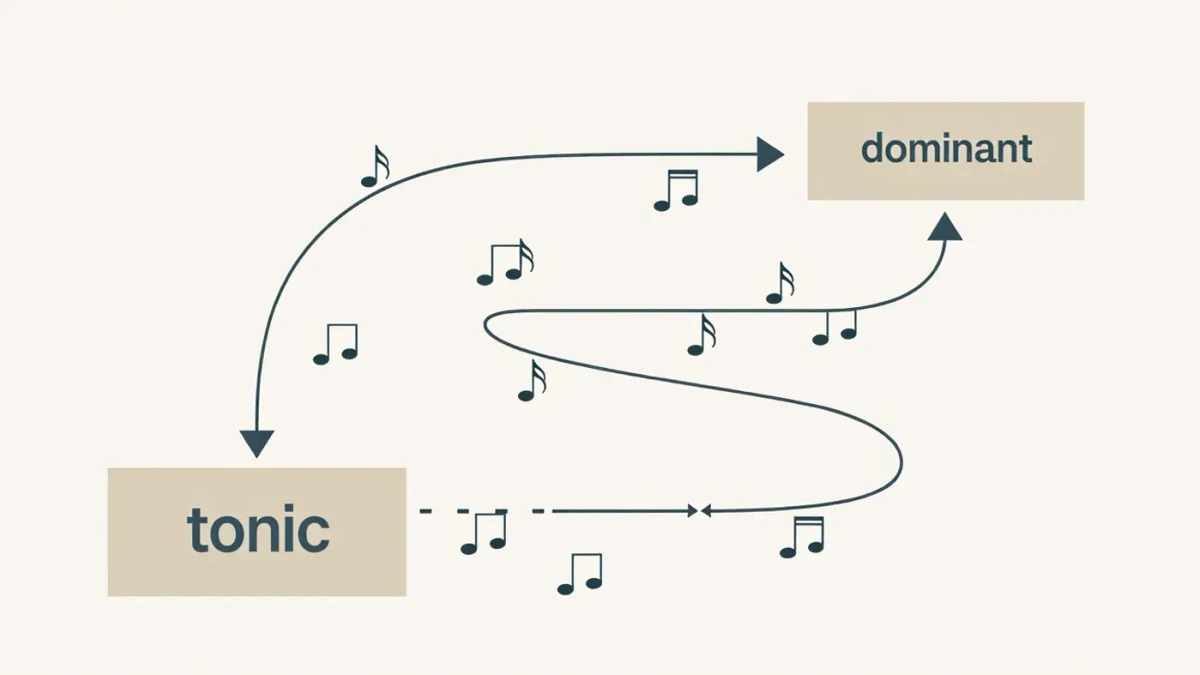
An unresolved film theme is one whose harmony keeps pointing home without arriving; the composer withholds the tonic chord so the music never quite finishes. The device has a long pedigree: the prelude to Wagner's Tristan und Isolde, first performed in Munich in 1865, delays its governing resolution until the opera's final scene.
Film composers inherited that postponement and put it to work under picture. A theme that closes is a statement; a theme that stays open is a question, and a two-hour story needs questions. The craft lies in keeping the question alive without exhausting the audience's patience.
What does resolution actually mean in music?
Resolution is a chord arriving where the preceding chords prepared it to arrive. In the tonal system that most film music still uses, the strongest arrival is the authentic cadence — the dominant chord, built on the fifth note of the scale, followed by the tonic — which is the grammatical full stop of Western harmony. Two weaker endings matter just as much for film. A half cadence stops on the dominant itself, landing the music on the chord that most wants to move, like a sentence ending on a comma. A deceptive cadence reaches for the tonic and lands on the sixth degree instead — a wrong doorstep, familiar from hymn settings and heartbreak ballads alike.
A composer with these three tools can end a cue at any level of openness, and audiences register the difference whether or not they can name it. Openness is not vagueness; it is engineered, chord by chord.
Why would a composer refuse to finish a theme?
Because a finished theme tells the audience the story is over, and most scenes are not. A melody that cadences fully behaves like a paragraph with a period; under a scene that is still developing, the period lies. Composers therefore write themes whose phrases end on dominants, on ambiguous chords, or on the dominant of a key other than home, so that the music keeps leaning forward into the next scene. Television scoring sharpens the problem further: a series theme must remain viable for dozens of hours, and an ending that closes hard each week eventually closes the audience out.
The technique also protects a theme's meaning. A resolved theme spends its harmonic charge; an unresolved one keeps the charge in reserve, letting a single final resolution — delayed for hours — carry the full weight of an ending when it finally comes.
Serial television makes the calculation a weekly habit. A series' main title has one job across dozens or hundreds of episodes: to reset the audience's attention without concluding anything, week after week, season after season. Open-ended construction is not a stylistic preference in that format; it is the only structure that survives repetition, because an ending that closes hard every week stops meaning anything by the third time it is heard.
How do composers build openness into the writing itself?
Cadence choice is the last step; the openness usually starts earlier, in how the theme is harmonized. A melody can be accompanied with chords borrowed from outside its key, so that every landing spot is tinged with a harmony that does not belong, and the ear keeps searching for a version of the tune accompanied by its own home chords. A theme can end its phrases on the dominant — the half cadence described above — so that each statement closes on the chord that most wants to move. A cue can simply end in a different key from the one it started in, modulation as exit, so that the music leaves home rather than returning to it.
Melodic shape cooperates with the harmony. Themes built from short cells — a rising third, a falling half-step — keep circling their own material without ever reaching the long descending line that, in classic song form, is the melodic equivalent of coming home. When cell and open cadence work together, a theme can run for minutes while feeling perpetually mid-sentence, which is precisely the state a suspense cue wants to sustain.
Related stories: Chords as Characters: how harmony signals who is on screen · Music That Listens Back: why video game scores tell stories no film can.
How does an unresolved theme work on screen?
Bernard Herrmann's score for Alfred Hitchcock's Vertigo (1958) is the canonical study. The love music, often analyzed against Wagner's Tristan prelude, sets alternating chord pairs in motion that never settle into a single home key; instead the pattern repeats higher and higher, intensifying without concluding, so that the music's inability to arrive mirrors the obsession it accompanies. The description is of effect, not intent — but the effect is audible in the cue's structure: oscillation in place of cadence.
At the opposite scale, John Williams's main idea for Jaws (1975) is barely a theme at all: two notes, a half-step apart, alternating and accelerating. It contains no cadence to resolve, no melodic destination — only approach, repeated. The shark's music can never arrive because arrival would mean the attack is over, and the score's terror lives exactly in the prolonging.
What happens when the theme is finally allowed to resolve?
The delayed cadence becomes the ending. Composers ration resolution across a whole score so that the final cue can spend everything saved: the home key arrives plainly, often at last over the end credits, and the audience feels closure it cannot fully attribute to anything but the picture ending. This is the same wager Wagner made with Tristan, where the harmony that opens the prelude finds its landing only in the closing Liebestod — resolution as death, or at least as finish.
The reverse also teaches the lesson. Schubert's Symphony No. 8 in B minor, the Unfinished, composed in 1822, stops after two movements, and listeners have been completing it in their imaginations for two centuries. An unresolved structure does not fail; it recruits the listener into finishing it, which is precisely the effect a serialized film or television score wants.
A caution belongs here as well. Stories about what a composer intended with an unresolved ending circulate freely in film-music lore, and most of them cannot be traced to a documented source. Unless the composer has said so in liner notes, an interview, or a published account, the honest description is the one this piece has used throughout: what the harmony does, and what it does to the scene under it.
Can audiences really hear an unresolved ending?
They can, even without training, because the expectation of the tonic is built by repetition long before the ending arrives. A soundtrack that keeps deferring arrival produces the same sensation as a cliffhanger: a held breath. That is why the device survives every change of style — it depends on no particular harmonic language, only on the audience's learned sense that music owes it a landing. Composers' sketches and manuscripts, preserved in collections such as those held by the Library of Congress's Performing Arts Research Center, often show the alternative endings considered and discarded before one was chosen.
And the lineage remains a working one. Munich, 1865: a prelude ends on a chord that seems to lean rather than rest, and a century of film composers took the hint — that the strongest endings are the ones the music has been refusing all along.